


Open this article in your preferred AI assistant. ChatGPT and Perplexity receive the prompt directly; Gemini and Claude open while the same summary prompt is copied for you.
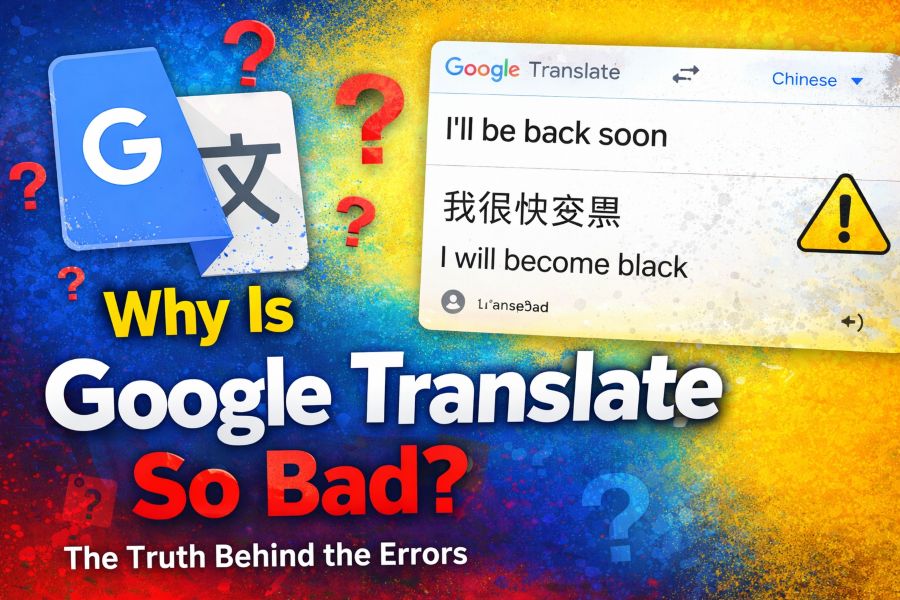
Google Translate is one of the most widely used tools for language translation today. While it’s incredibly convenient for basic translations, it often falls short when dealing with complex texts. Understanding why Google Translate is unreliable can help users make better choices when translating important documents or conversations.
Google Translate primarily relies on statistical models that use previous translations to predict the correct translation. This method can work well for straightforward, everyday phrases, but often fails with more nuanced or specialized language. It’s crucial to understand Google Translate’s limitations, especially if you’re relying on it for something important, such as legal or medical translations.
Keep reading for more information on why Google Translate is so bad.
Limitations of Google Translate’s Accuracy
One key issue with Google Translate is its lack of contextual understanding. Without recognizing the full context of a sentence, Google Translate can translate words in ways that don’t make sense in the target language. This leads to inaccurate translations, especially when dealing with idioms or phrases that don’t directly translate between languages. For instance, the tool struggles to provide meaningful translations for phrases with double meanings or cultural significance.
Google Translate also has no way of accounting for tone, style, or emotional nuance. For example, while translating a professional email, Google Translate might not capture the appropriate level of formality, making it sound either too casual or overly stiff. Similarly, it can mishandle expressions such as sarcasm, irony, or humor, which may not be immediately obvious from the words themselves but rely heavily on context.
If you’re working on a multilingual WordPress site translator, it’s important to consider these inaccuracies when selecting translation tools. Many websites rely on Google Translate for quick fixes, but they risk losing visitors’ trust due to translation errors.
The Impact of Misunderstandings in Critical Fields
Google Translate’s limitations are particularly problematic in critical fields such as medicine and law. These sectors often rely on precise and accurate language, where even the slightest misinterpretation can have serious consequences. In medical translations, Google Translate has been known to mistranslate essential terminology, potentially leading to errors in treatment or care.
Moreover, legal documents, which must be both precise and clear, often don’t translate well through Google Translate. Legal jargon, specific terminology, and culturally specific concepts are often lost in translation. Misunderstanding terms or legal nuances can lead to severe repercussions, such as invalidated contracts or misunderstandings in court.
For legal practitioners, it’s better to use specialized legal translation services to ensure accuracy. Google Translate, despite its convenience, often cannot guarantee the level of precision required for these sensitive fields.
Inability to Handle Complex Sentences
Another common issue with Google Translate is its inability to accurately translate complex sentence structures. While short sentences or basic vocabulary may work, longer and more intricate sentences can lead to jumbled translations. Complex grammatical structures or nested clauses often result in awkward translations that can confuse the reader.
Additionally, Google Translate does not understand sentence structure across different languages. For example, in languages like German, the verb often comes at the end of the sentence, whereas in English it is generally placed earlier. This lack of understanding can lead to translations that are not just incorrect but completely nonsensical.
If your business needs to communicate effectively across multiple languages, it’s vital to use a tool that can handle complex sentence structures with accuracy. Tools like multilingual WordPress site translators can deliver more reliable results for websites catering to diverse audiences.
The Problem of Privacy and Security
Another concern with using Google Translate is privacy. Since the tool stores translations in its database, sensitive or confidential information may be exposed. Users are unknowingly sharing private details with Google, which could be accessed later. This is a significant issue for businesses and individuals who need to translate confidential documents.
When using Google Translate to translate medical or legal documents, the risk of data misuse or exposure increases. Medical translations often include personal health information, while legal translations might involve sensitive case details. Protecting this information requires a more secure translation service that prioritizes privacy, unlike Google Translate, which lacks the safeguards needed to protect confidential data.
Google Translate’s Dependence on Neural Networks
Despite these challenges, Google Translate has made significant advancements with the introduction of Neural Machine Translation (NMT). This system uses deep learning to analyze entire sentences rather than just individual words, thereby improving translation accuracy. However, even with NMT, the tool still faces challenges in understanding complex linguistic structures and idiomatic expressions.
The transition to NMT represents a significant improvement over the previous system, but it doesn’t solve all the problems associated with translation errors. While Google Translate is certainly more advanced than it was in the past, it still isn’t capable of providing the nuanced understanding required for specialized or sensitive translations.
If you’re looking for a more reliable translation solution, tools designed for specific fields—such as medical or legal translations—are more likely to meet your needs. They utilize professionals who understand both the language and the context, which is crucial for accuracy.
Lack of Cultural Sensitivity
Cultural nuances are another area where Google Translate falls short. Language isn’t just about words; it’s also about cultural context, which Google Translate often fails to capture. In many languages, certain phrases or words can carry cultural meanings that don’t translate directly into English. For example, words or phrases in Arabic, Mandarin, or Spanish may have connotations that Google Translate doesn’t grasp, leading to awkward or inappropriate translations.
Relying on Google Translate for culturally significant translations risks offending your audience or missing the mark with your message. This is why it’s crucial to use translation services that understand both the language and the culture behind the words, especially when communicating with international audiences.
Why Google Translate Struggles with Idiomatic Phrases
Idioms and phrases are some of the most difficult aspects of language translation, and Google Translate often gets them wrong. Phrases like “raining cats and dogs” or “break a leg” can confuse the tool, as it tries to translate them word-for-word rather than understanding their intended meaning. This is a major issue for people relying on Google Translate to understand colloquial or culturally specific expressions.
When translating important documents, such as marketing materials or customer communications, idiomatic expressions need to be handled carefully to avoid misunderstandings. A professional translator, with an understanding of both the language and its cultural context, is far better equipped to address these challenges than Google Translate.
Conclusion:
While Google Translate is a valuable tool for quick translations of basic sentences, its flaws make it unsuitable for high-stakes or sensitive translations. Misunderstandings, privacy issues, and lack of cultural sensitivity are just a few of the drawbacks that can cause problems. Businesses and individuals who require accurate, reliable translations should consider specialized services that understand both the language and the context.
For multilingual websites, tools like multilingual WordPress site translators offer more precision and security. These tools are specifically designed to handle complex, industry-specific terms and can help businesses communicate more effectively with a global audience.
If you’re seeking professional, accurate translations, investing in specialized services rather than relying on Google Translate is a smart decision.
FAQs
What makes Google Translate inaccurate?
Google Translate often fails with context, idioms, and specialized terms. It lacks an understanding of sentence structure and cultural nuances, leading to awkward or incorrect translations, especially in complex texts such as legal or medical documents.
Can Google Translate handle legal documents?
No, Google Translate struggles with legal language. It misinterprets legal terms, which can lead to errors that may invalidate contracts or create misunderstandings in legal matters. For important legal translations, professional services are highly recommended.
Why does Google Translate fail with idioms?
Google Translate translates idioms literally, causing confusion. For example, “raining cats and dogs” or “break a leg” may not make sense in other languages. Such expressions require cultural context, which Google Translate fails to grasp accurately.
Is Google Translate secure for confidential information?
No, using Google Translate for sensitive information is risky. It stores translations in its database, potentially exposing private data. For confidential documents, it’s better to rely on secure, specialized translation services that prioritize privacy.
Can Google Translate handle complex sentences?
Google Translate struggles with complex sentence structures. While it works well with simple phrases, it often fails with nested clauses or intricate grammar, leading to awkward or incorrect translations, particularly in technical or professional writing.
Why is Google Translate bad with medical terms?
Google Translate lacks the accuracy needed for medical translations. It often misinterprets complex medical terminology, leading to dangerous errors. Professionals in the medical field should use dedicated translation services for precise communication.
Does Google Translate account for cultural context?
No, Google Translate doesn’t fully capture cultural nuances. It might translate words directly but fails to understand the context, idiomatic expressions, or the cultural significance of certain terms. This makes it unsuitable for sensitive or cultural communications.
How accurate is Google Translate for basic translations?
For simple, everyday translations, Google Translate works fairly well. However, when dealing with complex phrases, specialized vocabulary, or culturally nuanced content, its accuracy significantly drops, leading to unreliable translations for professional or important texts.
Can Google Translate handle multiple languages at once?
Yes, Google Translate can handle translations between multiple languages in a single document. However, it may struggle to maintain accuracy when translating between more than two languages, especially when context or specialized terms are involved.
What alternatives are better than Google Translate?
For greater accuracy and specialized fields, consider alternatives such as professional translation services or tools designed for legal, medical, or technical translation. These options offer more precise, context-aware translations, especially when reliability and clarity are essential.

Comments
0 responsesNo comments yet. Be the first to share your thoughts.