What Is Multilingual SEO?
Multilingual SEO is the process of optimizing a website for search queries in more than one language. Its goal is to help people find relevant content in their preferred language through organic search.
For example, imagine you own an online store that sells hiking equipment. Your English website targets customers who search for "hiking boots." To reach customers in Germany, you create German product pages and research the terms they use.
However, translating your product descriptions is only the beginning. Your German pages also need relevant keywords, clear URLs, and suitable metadata. Search engines must be able to access and index them.
An effective multilingual website combines four essential elements:
When these elements work together, your website becomes easier to discover and use across different languages.
Multilingual SEO vs. International SEO: What's the Difference?
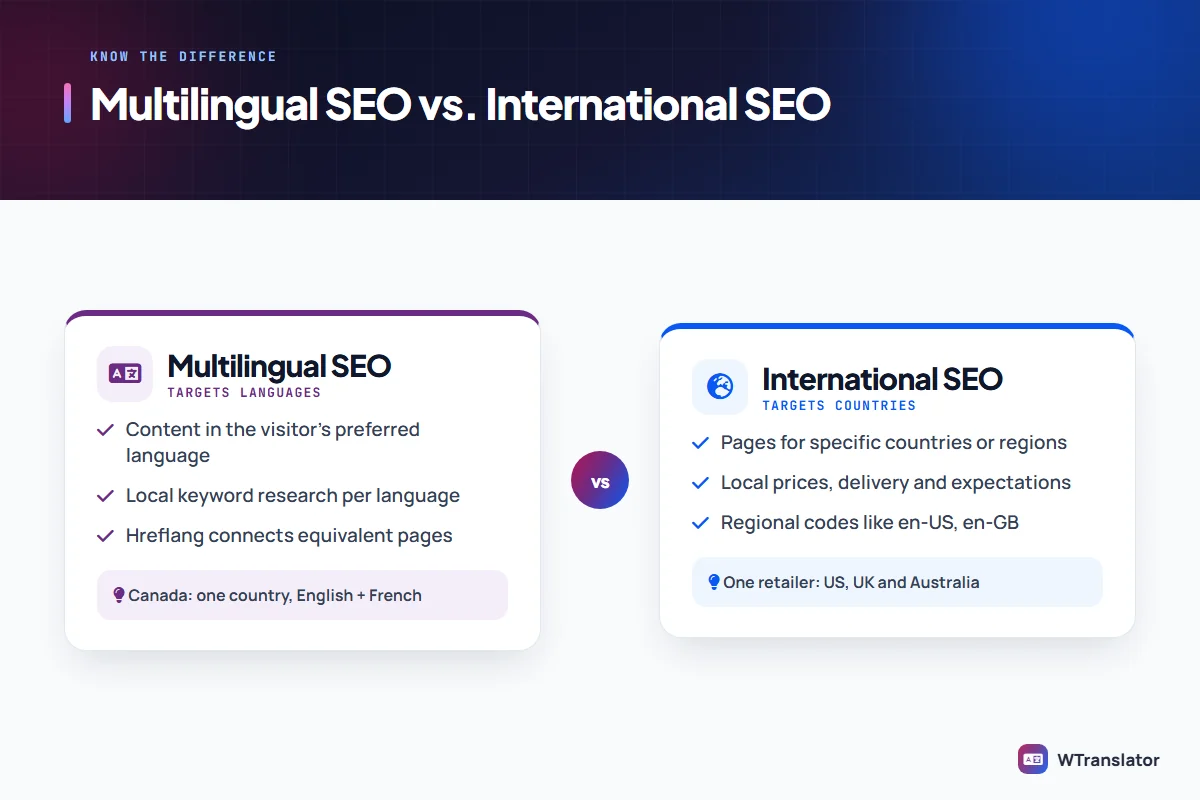
Multilingual SEO and international SEO are closely related, but they have different goals.
Focuses on language. It helps people find content in their preferred language, regardless of their location.
Focuses on geographic markets. It helps websites reach people in specific countries or regions.
For example, a Canadian business may provide content in English and French. This is a multilingual SEO strategy within one country.
A clothing retailer may target the United States, United Kingdom, and Australia. It can use international SEO to address different prices, delivery options, and customer expectations.
Many international businesses need both approaches. A company expanding into France, Germany, and Canada may require translated content, regional keyword research, and country-specific landing pages.
Google explains these distinctions in its guidance for multilingual and multi-regional websites.
Why Multilingual SEO Matters for Business Growth
A multilingual website can create new business opportunities without requiring a separate brand for every market. However, success depends on how well you understand each audience.
1. Reach Customers Who Search in Their Own Language
Many customers begin their online research in their preferred language. If your website only targets English keywords, you may miss relevant searches in other languages.
Suppose your company sells project management software. A French business owner may search for software using French terms rather than English ones. A properly optimized French landing page gives your business an opportunity to appear for those searches.
This approach expands your potential search visibility without relying only on paid advertising.
2. Create a More Comfortable Buying Experience
Visitors need more than translated headlines. They also need to understand product features, payment terms, delivery conditions, and customer support information.
A website may attract international visitors but still lose potential customers during checkout. For example, a German shopper may reach a translated product page but find English shipping instructions. This creates unnecessary confusion.
Consistent localization helps visitors complete their tasks with fewer language barriers.
3. Build Trust in New Markets
Customers often look for signs that a business understands their needs. Clear language, accurate product information, and local contact details can support that trust.
A professional multilingual website also helps visitors evaluate your business before they make a purchase. However, translation alone does not establish credibility. Your information must remain accurate, useful, and consistent across languages.
4. Support Long-Term Organic Growth
Each well-optimized language version can target relevant search queries. Over time, these pages may attract qualified visitors from different markets. This creates opportunities to grow your audience beyond your original language.
How to Build a Successful Multilingual SEO Strategy
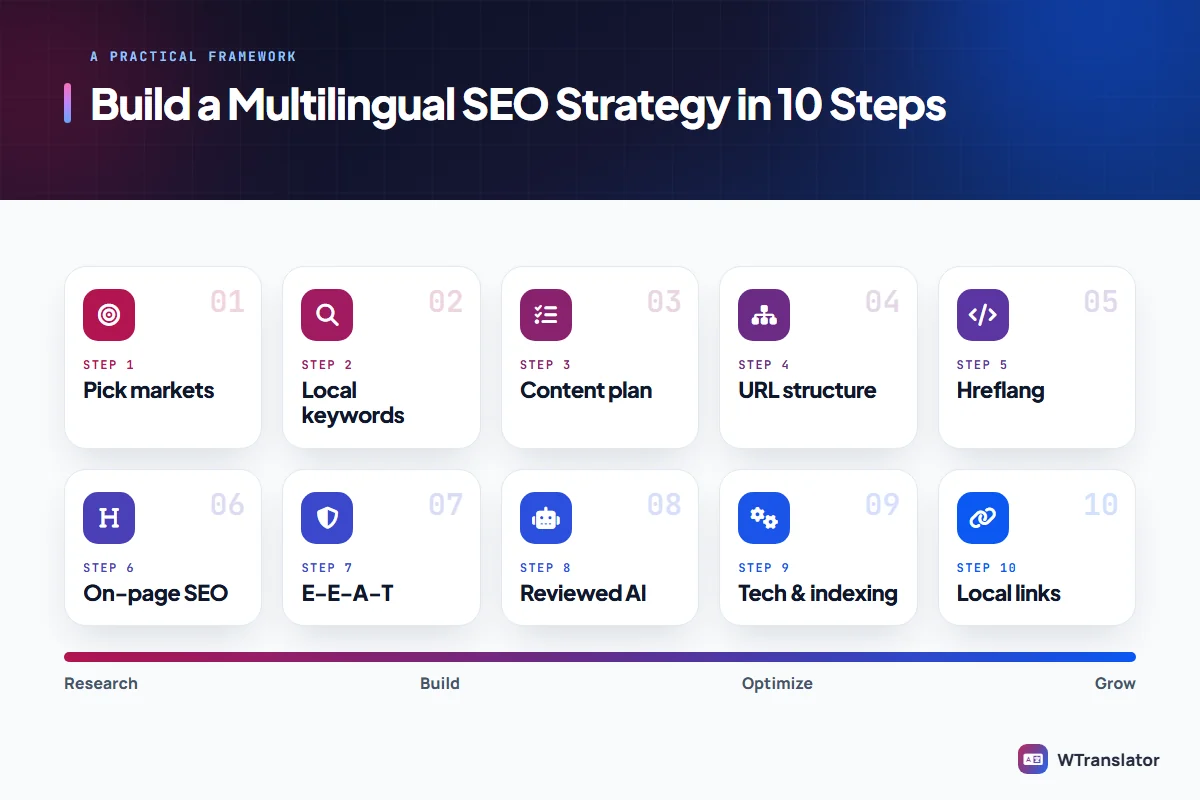
A good multilingual SEO strategy starts with research, not translation. Before you publish new language pages, identify your target markets and understand what customers need. The following steps provide a practical framework.
Step 1 Identify Your Target Languages and Markets
Start by choosing the countries and languages that offer realistic growth opportunities. Avoid translating your entire website into dozens of languages without a clear business goal. Instead, evaluate where your products or services already attract interest.
Use these factors to compare markets:
Google Search Console can help you review search performance by country. Website analytics can also show where visitors come from and what they do.
For example, suppose your English website already receives relevant visitors from France. That activity may justify researching French search terms and testing a French landing page. However, geographic traffic alone is not proof of demand. Compare the findings with sales data and competitor research.
Step 2 Conduct Multilingual Keyword Research
Multilingual keyword research is one of the most important parts of international search optimization. A direct translation of an English keyword may not match how local customers search.
People in different regions may use different terms for the same product. Their search intent may also differ. For example, an English store may target "running shoes." A French translation could produce "chaussures de course." However, other terms may better match a specific audience or product category.
You cannot determine the best keyword through translation alone. You need search data and local knowledge.
How to Research Keywords in Different Languages
Follow this process for each target market:
Choose your target country.
Define the audience before collecting keywords.
List your main topics.
Start with products, services, and customer problems.
Create translated seed keywords.
Use them as research ideas, not final selections.
Use a keyword research tool.
Set the correct country and language.
Review local search results.
Identify the pages that match each query.
Check search intent.
Separate informational, commercial, and transactional searches.
Validate your keyword list.
Ask a qualified native-language reviewer to check terminology.
Assign keywords to pages.
Give each important page a clear search purpose.
Tools such as Google Keyword Planner, Google Trends, Semrush, and Ahrefs can support this research. Focus on more than search volume. Consider keyword difficulty, business relevance, and the type of content that appears in search results.
A keyword with modest search volume may offer valuable traffic if it closely matches your product.
Example: Keyword Research for an Online Store
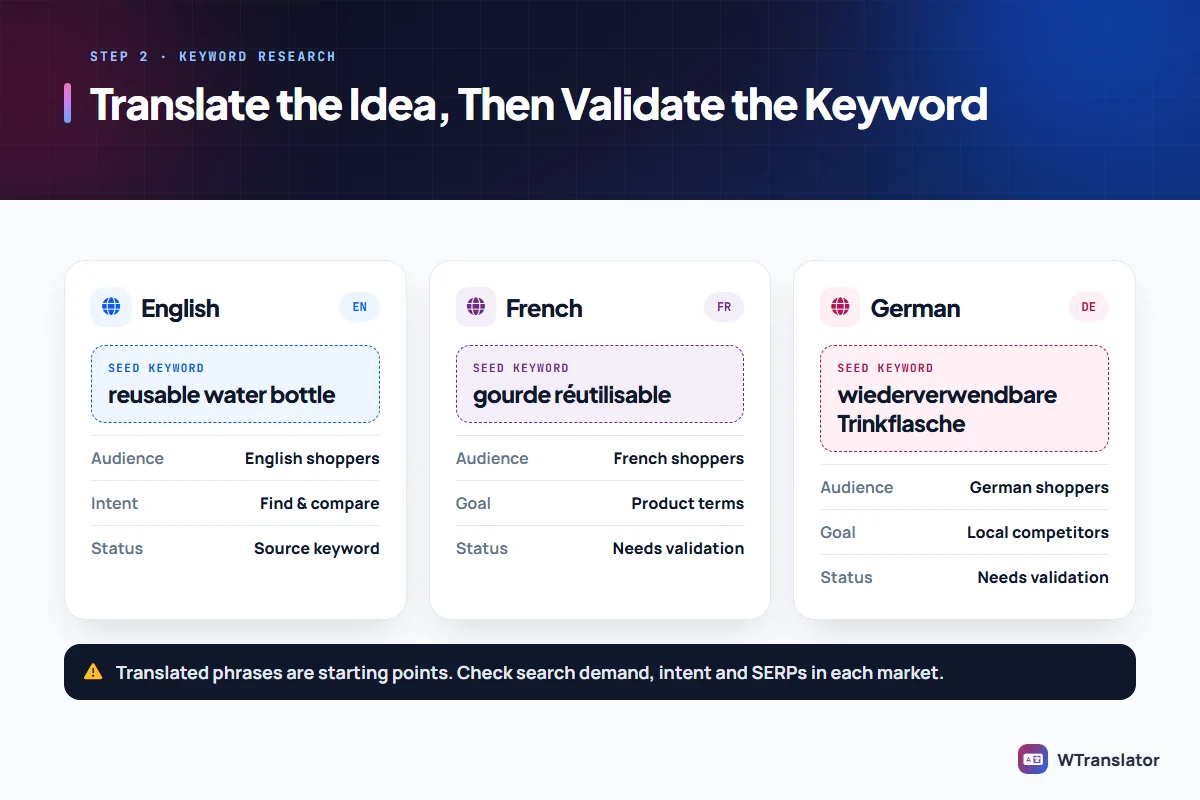
Imagine an English-language store that sells reusable water bottles. Its main keyword is "reusable water bottle." The business wants to reach customers in France and Germany. The research process might look like this:
| Market | Topic / starting keyword | Audience | Intent / research goal |
|---|---|---|---|
| English market | Product topic: Reusable water bottles | English-speaking shoppers | Search intent: Find and compare products |
| French market | Starting keyword: Gourde réutilisable | French-speaking shoppers | Research goal: Identify relevant product terms and buying intent |
| German market | Starting keyword: Wiederverwendbare Trinkflasche | German-speaking shoppers | Research goal: Compare alternative terms and local competitors |
These translated phrases are starting points, not verified keyword recommendations. Check their actual search demand and relevance before using them in your content.
This process helps you select keywords based on customer behavior rather than assumptions.
Step 3 Build a Localized Content Plan
Once you identify your target keywords, decide which pages to translate first. Not every page deserves the same priority. Begin with content that supports your main business goals.
For an online store, priority pages may include product categories, popular products, shipping information, and return policies.
For a SaaS business, priority pages may include software features, pricing, integrations, product comparisons, and help guides.
A useful content plan connects every important page to three things:
- A target language and market
- A primary keyword and search intent
- A clear business or user goal
Translation vs. Localization
Translation changes text from one language into another. Localization adapts the content to suit the language, culture, and expectations of a specific audience.
For example, a product page may need more than translated descriptions. You may also need to adapt its currency, measurements, delivery details, and payment information.
Customer testimonials require similar care. Use genuine customer feedback, and explain its original market when relevant. Avoid creating fictional local reviews to make a page appear more trustworthy.
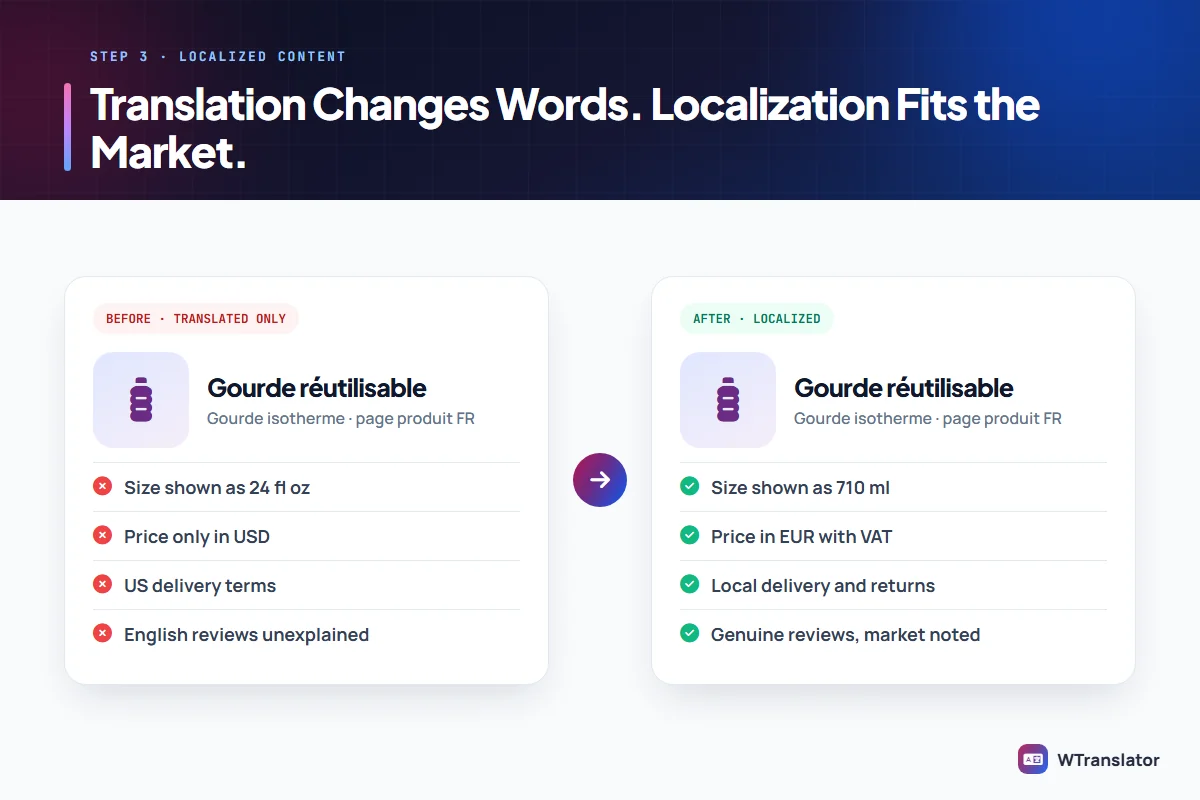
A visitor finds a translated product description but sees unfamiliar measurements and delivery terms.
The page explains the product using suitable units, clear delivery information, and familiar terminology.
The second experience helps visitors make informed decisions.
Step 4 Choose an SEO-Friendly URL Structure
Your URL structure helps search engines discover different language versions of your website. Google recommends using separate URLs for each language version rather than relying only on browser settings or cookies.
There are three common approaches.
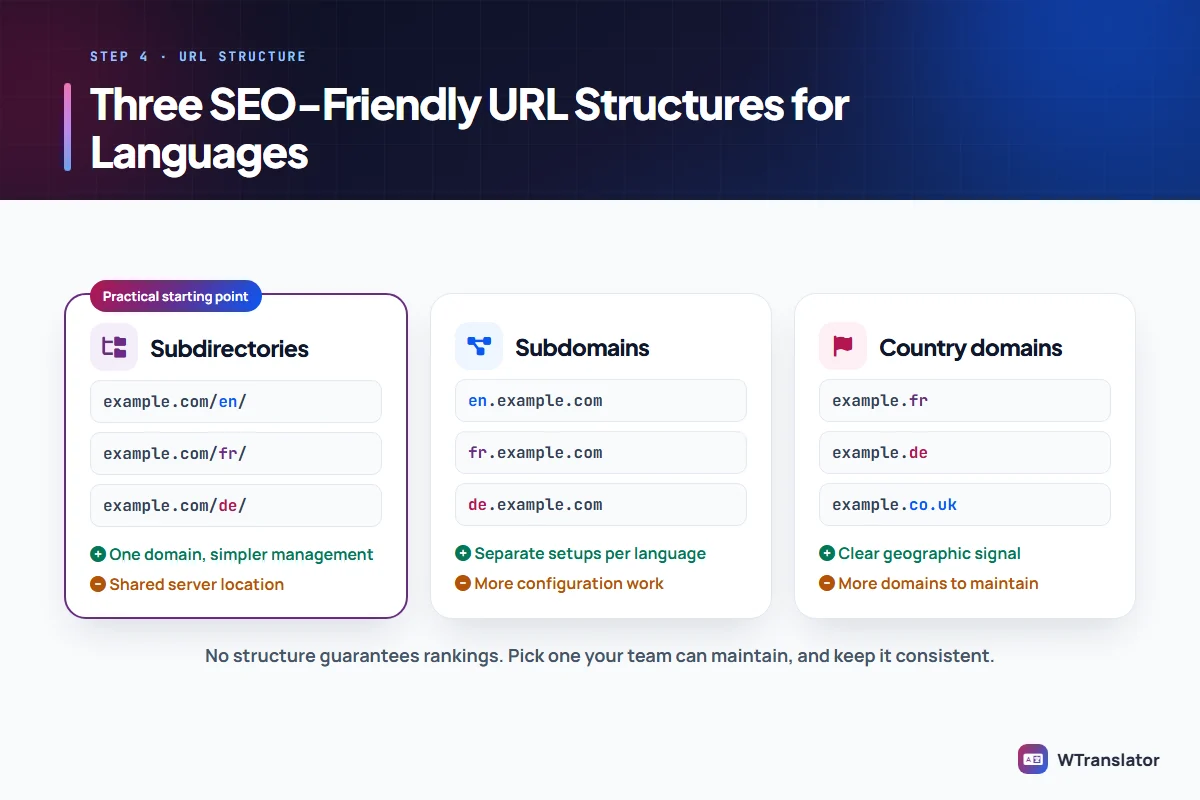
Which URL Structure Is Best?
There is no single structure that guarantees better rankings. For many small and medium-sized businesses, subdirectories offer a practical starting point. Larger companies may benefit from subdomains or country-code domains when their operations require them.
Choose a structure that your team can maintain. Keep it consistent as your multilingual website grows.
Step 5 Complete Hreflang Tag Implementation
Hreflang tags help Google understand which language or regional version of a page to show in search results. They are particularly useful when several pages provide equivalent content for different audiences.
For example, consider these URLs:
- English page:
https://example.com/en/shipping/ - French page:
https://example.com/fr/livraison/
Both pages explain shipping policies in different languages. You can use hreflang annotations to identify their relationship.
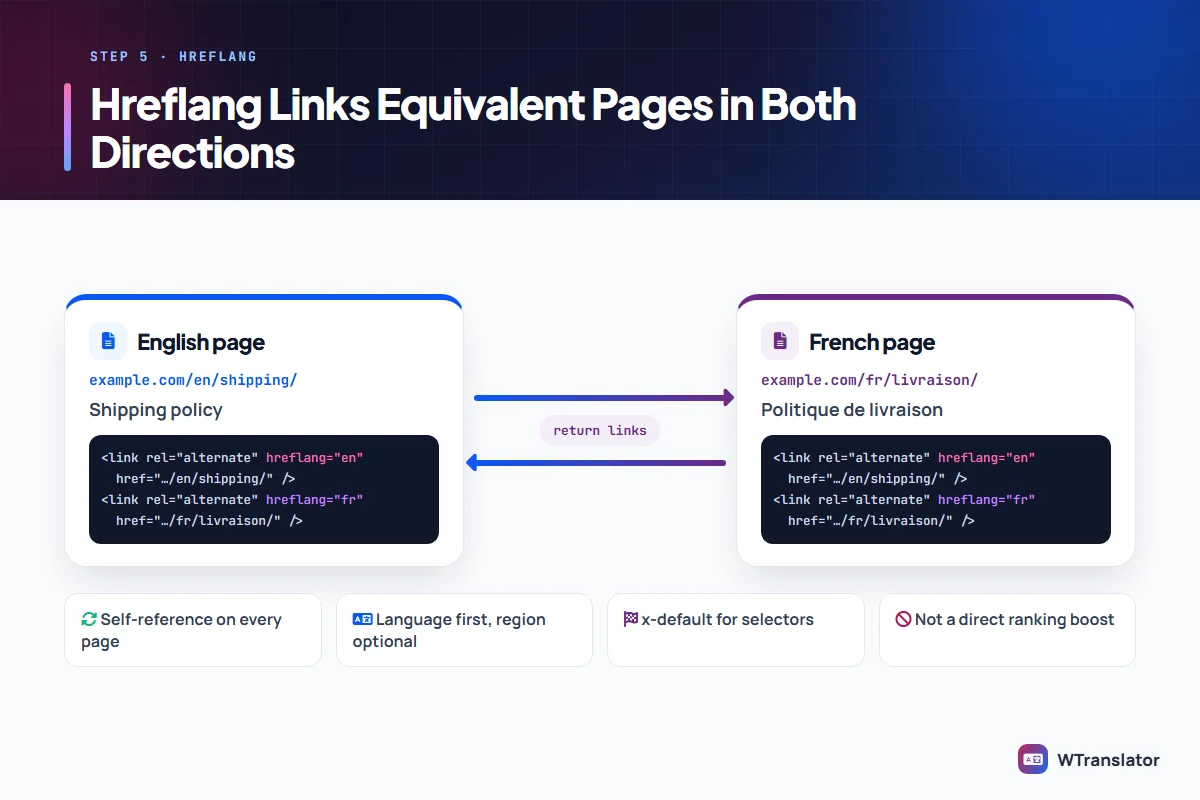
Basic Hreflang Example
Add the following markup to the HTML head of both pages:
<link rel="alternate" hreflang="en" href="https://example.com/en/shipping/" />
<link rel="alternate" hreflang="fr" href="https://example.com/fr/livraison/" />
The first line identifies the English version. The second line identifies the French version.
Each page must reference itself and the other language version. The relationship must work in both directions.
You can also use regional codes when your content targets a specific location. Examples include:
en-US English in the United States
en-GB English in the United Kingdom
fr-CA French in Canada
de-DE German in Germany
Use a language code first. Add a region code only when necessary. For websites with a language selector or a general fallback page, x-default may also be useful.
Google supports hreflang annotations through HTML, HTTP headers, and XML sitemaps. You only need one correctly maintained implementation method.
For technical details, consult Google's official hreflang documentation.
Common Hreflang Mistakes
Even a small configuration error can make hreflang annotations less useful. Check for:
Remember that hreflang does not translate content or guarantee rankings. Its main purpose is to help Google identify the appropriate language or regional version.
Step 6 Optimize On-Page SEO for Every Language
Multilingual website optimization requires more than translating the main text. Each language version needs its own clear and relevant SEO elements.
Localize Page Titles and Meta Descriptions
Your title should explain the page topic using natural language. Include the main local keyword where it fits. Your meta description should summarize the page and give users a reason to visit.
Avoid translating English metadata word for word without reviewing its meaning. For example, a French product category may need a different title structure from the English version. The final wording should match local search intent.
Review Headings and Page Content
Make sure the main heading explains the page clearly. Use supporting headings to organize information. Avoid forcing keywords into every heading or paragraph.
Your content should answer the questions people ask in each target market.
Optimize Images and Product Details
Review image alt text when it needs translation. Check product measurements, dates, pricing, and other local details.
If you use structured data, make sure it represents the visible content accurately. For example, product offers should match the price and availability shown on that page.
Improve Internal Linking
Link related pages within the same language whenever suitable. A French product page should generally link to French category pages, guides, and support information when they exist. This makes navigation easier and helps search engines discover related content.
Also provide a clear language switcher. Visitors should be able to change languages without losing access to the content they need.
Step 7 Apply Google's E-E-A-T Principles to Multilingual Content
Google's E-E-A-T framework stands for:
Google states that E-E-A-T is not a single, direct ranking factor. Instead, its ranking systems use signals that may reflect these qualities. Trust is especially important.
Read more in Google's people-first content guidance.
Show Real Experience
Use practical examples that help readers understand a product or topic. For a software website, this may include original screenshots, tutorials, and verified product information.
Translate those details carefully so they remain accurate. A translated guide should not describe features that the product does not offer.
Demonstrate Expertise
Have qualified reviewers check content that requires specialist knowledge. This is particularly important for legal, medical, financial, and technical topics.
A translator may understand the language but not the subject. For sensitive content, involve people with both language skills and relevant expertise.
Support Authoritativeness
Publish useful content that other websites have a reason to reference. You can also build relationships with relevant publications and experts in each target market.
Avoid treating backlinks as a substitute for content quality. Strong local references should support information that is already helpful and accurate.
Strengthen Trustworthiness
Give visitors clear information about your business. Use accurate author details, relevant sources, and transparent policies. Keep contact information and business terms consistent.
When you adapt claims for a new market, verify that those claims remain valid. For example, a software product may have features that differ by subscription plan. Your translated pricing page should reflect the actual plan details.
Step 8 Use AI Translation Without Sacrificing Quality
AI translation can reduce the manual work involved in creating multilingual content. It can help businesses prepare initial translations, especially when they manage large websites.
However, automatic translation does not replace keyword research, content review, or technical SEO. A translated page may read well but still use the wrong product term. It may also miss cultural details or change the meaning of an important statement.
Use a controlled process:
Generate an initial translation.
Use a suitable translation tool.
Check important terms.
Review product names, keywords, and technical language.
Review the content.
Ask a qualified reviewer to check meaning and clarity.
Verify critical information.
Check prices, policies, and product claims.
Test the page.
Confirm that visitors can use the translated content.
Google does not prohibit content simply because AI helped create it. However, creating large amounts of low-value content mainly to manipulate rankings can violate Google's spam policies. This includes certain forms of automated translation that add little value for users.
The safest approach is to publish useful, reviewed content that meets genuine audience needs.
For WordPress websites, a translation plugin can help manage this workflow. For example, WTranslator offers WordPress translation features and a language switcher. Its paid plans also provide SEO-focused capabilities, including indexable translated pages and SEO-friendly URLs.
These features can support the technical side of multilingual SEO. You still need to validate keywords and review important translations.
Step 9 Check Technical SEO and Indexing
Your translated pages must be accessible before they can compete in organic search. Start by checking whether search engines can discover and index the correct URLs.
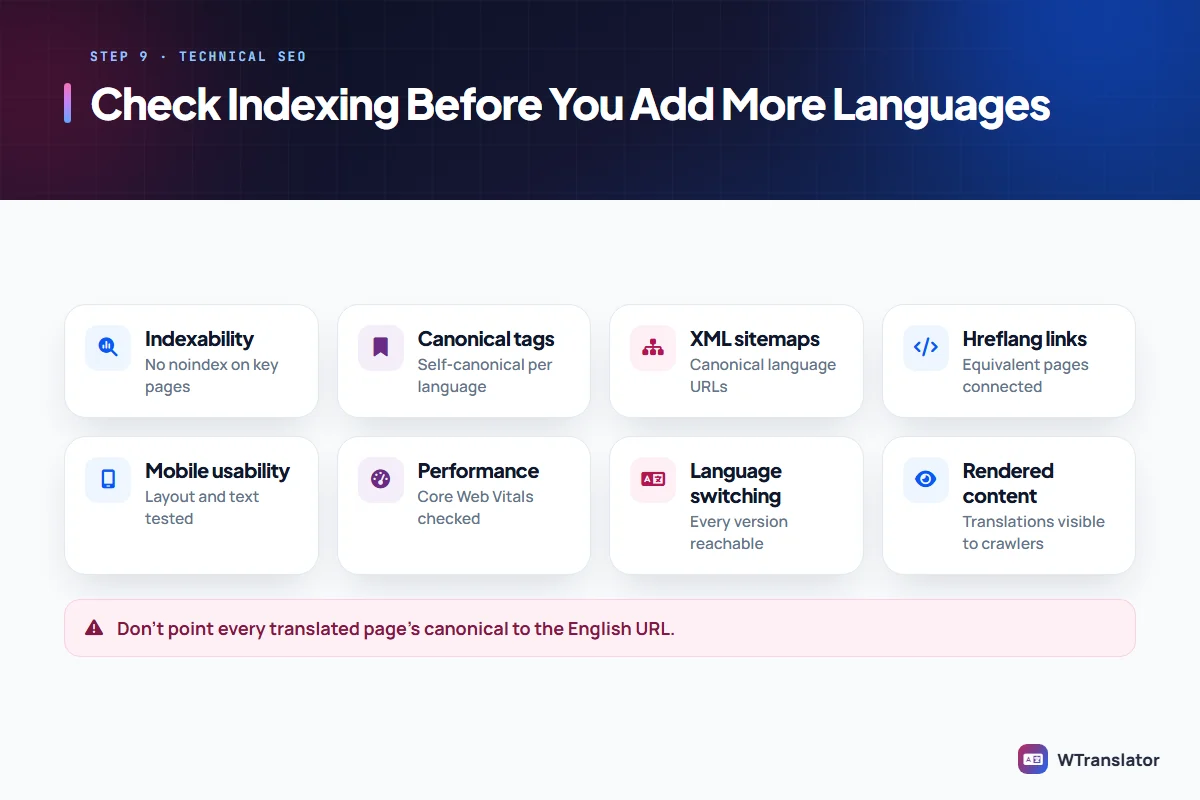
Review these elements:
Pay special attention to canonical tags. Do not automatically point every translated page to the original English URL. Google may then treat the original page as the preferred version, which can affect how translated pages appear in search.
Google recommends using a canonical page in the same language when working with hreflang. You should also avoid automatic redirects that prevent users or search engines from accessing other language versions.
Use Google Search Console's URL Inspection tool to examine representative pages. Check their index status and the canonical URL selected by Google.
Fix technical issues before expanding into more languages.
Step 10 Build Relevant Links in Each Target Market
Links from relevant websites can help people discover your multilingual content. They can also support your wider SEO efforts.
However, effective international link building requires local context. A successful outreach campaign in one country may not work in another. Research websites that serve your target audience.
Suitable opportunities may include:
Create resources that these websites would find useful. For example, a software company could publish a French guide about a problem that French businesses frequently face. The company could then share the guide with relevant publications.
Focus on editorial relevance rather than buying large numbers of low-quality links. Your goal is to earn useful exposure and build lasting credibility.
How to Measure Multilingual SEO Performance
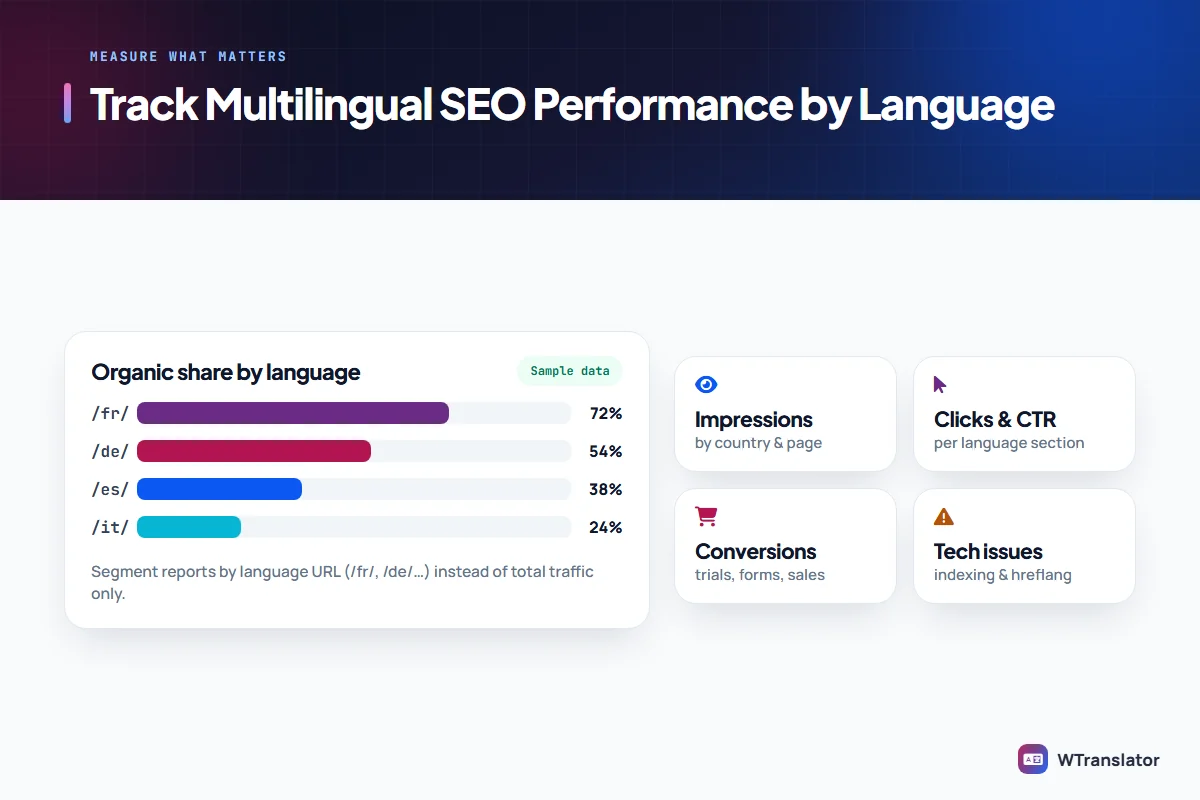
Publishing translated pages is not the end of the process. You need to measure whether your website attracts the right visitors and helps them achieve their goals. Track performance separately for each important language or market.
1. Organic Search Visibility
Monitor impressions, clicks, and average position for relevant queries. Google Search Console lets you review search performance by country, page, and query.
Where your URL structure allows it, use page filters to examine language sections. Remember that a country filter does not always identify the visitor's preferred language.
2. Engagement and Conversions
Traffic alone does not show business success. Measure what visitors do after they reach your website. Useful metrics include:
Compare results with your baseline and review trends over time. For example, increased French organic traffic may look promising. However, you should also check whether those visitors complete meaningful actions.
3. Technical Performance
Monitor indexing problems, broken links, redirect errors, and hreflang issues. Check important pages after you change your URL structure or update your translation system. A technical error can affect many language pages at once.
4. Content Performance
Identify which translated pages attract relevant visitors. Review pages that receive impressions but few clicks. Their titles or content may not match local expectations.
Also examine pages that attract visitors but fail to convert. They may contain unclear messages, missing information, or unsuitable calls to action.
As Matomo explains in its multilingual SEO measurement guide, segmenting reports by language-specific URLs can help teams understand performance across markets.
Use these findings to improve your strategy.
A Practical 90-Day Multilingual SEO Plan
You do not need to translate your entire website at once. A phased approach makes it easier to control quality and measure results.
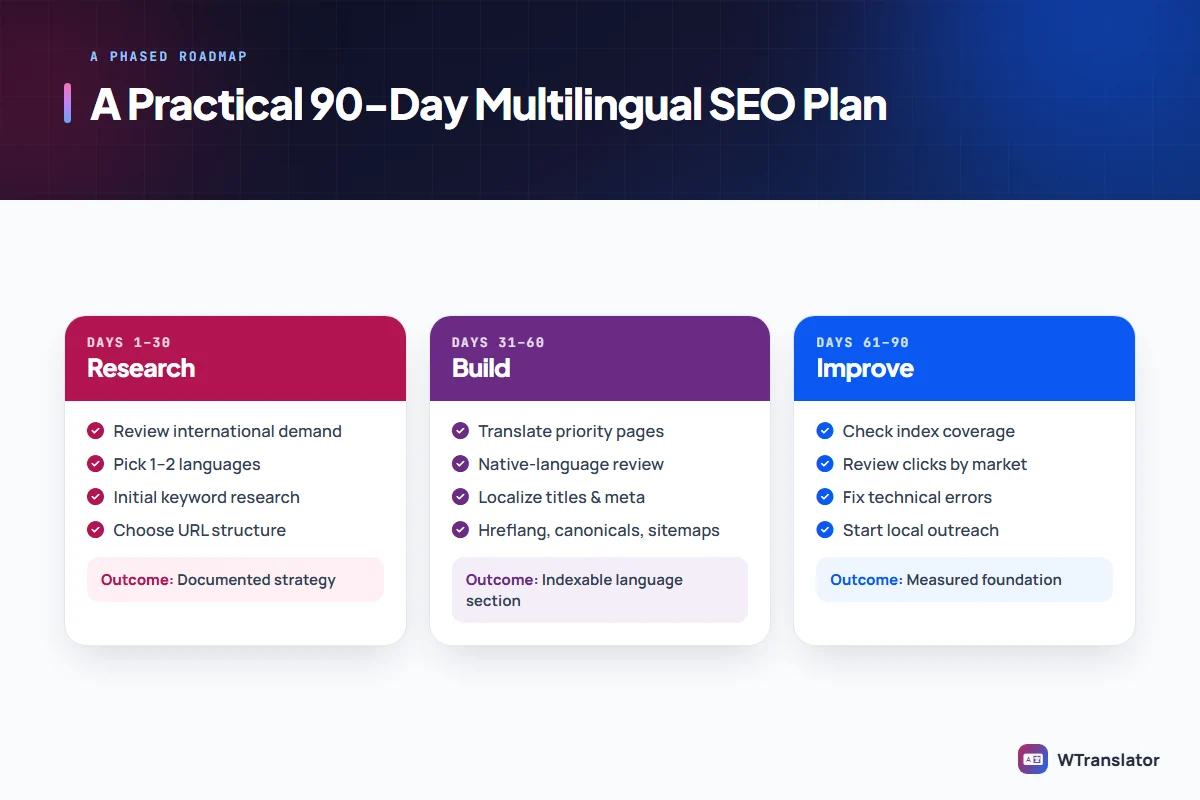
Research and Preparation
Focus on selecting a market and preparing the website.
- Review existing international traffic and business demand.
- Select one or two target languages.
- Complete initial keyword research.
- Choose your URL structure.
- Audit your current SEO setup.
- Identify the first pages to localize.
Content and Technical Setup
Focus on publishing useful language versions.
- Translate your highest-priority pages.
- Review terminology with qualified language experts.
- Optimize page titles, descriptions, and headings.
- Configure language-specific URLs.
- Implement hreflang annotations.
- Check canonical tags and sitemaps.
- Test navigation and important conversion paths.
Monitoring and Improvement
Focus on learning from the first results.
- Check index coverage.
- Review impressions and clicks by market.
- Improve pages with weak engagement.
- Fix technical errors.
- Start relevant local outreach.
- Update translations when source content changes.
- Plan your next group of pages.
Common Multilingual SEO Mistakes to Avoid
Even a well-designed website can struggle when its language strategy contains basic errors.
Translating Keywords Without Research
Direct translations can miss local search terms. Research each target market before selecting keywords.
Publishing Language Versions Without Unique URLs
A language switcher alone does not ensure that translated content has separate, indexable URLs. Check how your translation system delivers pages to search engines.
Using Incorrect Hreflang Tags
Broken language references can make it harder for Google to connect equivalent pages. Audit hreflang annotations after every major change.
Ignoring Local User Experience
A translated headline will not solve problems caused by unclear checkout instructions or missing support information. Review the complete user journey.
Publishing Unreviewed Content at Scale
Automatic translation can save time, but errors can spread across many pages. Use human review where accuracy and trust matter most.
Measuring Only Total Traffic
Overall traffic may hide poor performance in individual markets. Track search visibility, engagement, and conversions by language section.
Multilingual SEO Checklist Before You Publish
Use this checklist before launching a new language.
0 of 14 checks complete
Frequently Asked Questions About Multilingual SEO
1. What is multilingual SEO?
2. How is multilingual SEO different from international SEO?
3. Does multilingual SEO help increase website traffic?
4. Do I need separate URLs for every language?
5. Are hreflang tags necessary for multilingual SEO?
6. Can I use AI translation for multilingual SEO?
7. Should I translate every page on my website?
8. How long does multilingual SEO take to work?
9. Which URL structure is best for multilingual SEO?
10. How do I measure multilingual SEO success?
Final Thoughts: Build a Multilingual Website That People Can Find and Trust
Multilingual SEO is not simply about making your website available in more languages. It is about helping the right people discover useful content, understand your business, and take action.
Start with local keyword research. Create accurate translations, use clear URLs, and configure your technical SEO correctly. Then measure performance and improve your content based on real customer behavior.
If you manage a WordPress website, the right translation system can make this process easier.
Ready to make your WordPress website multilingual?